
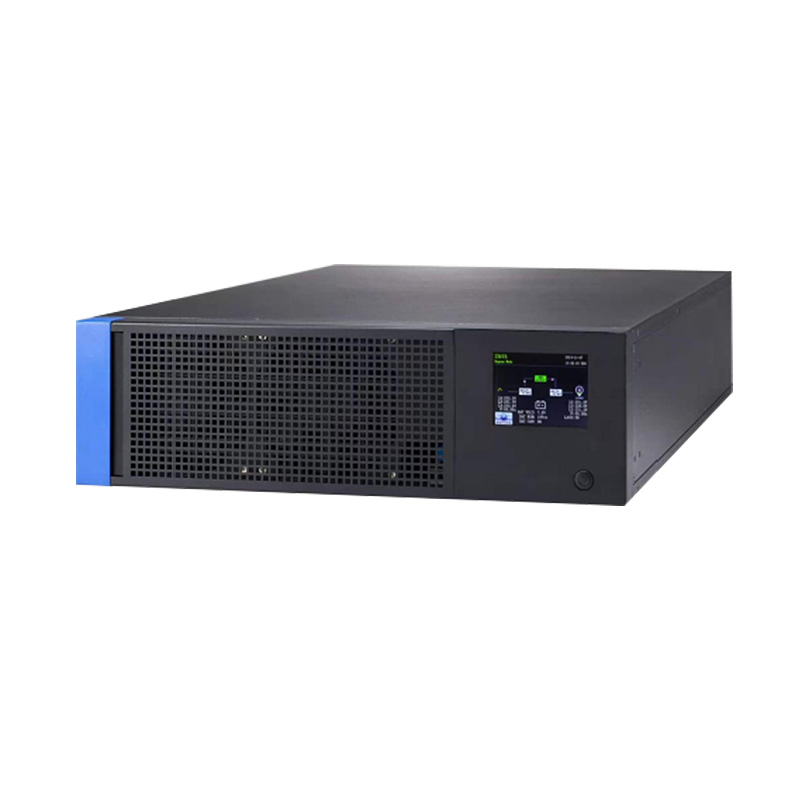
Three-phase UPS input and output configurations
A three-phase UPS is described by two numbers — how many phases go in, how many come out. Getting that pairing wrong is one of the few mistakes that cannot be corrected after installation, because it fixes the output distribution board, the neutral conductor and every downstream circuit.
The short answer
Take three-in, three-out (3/3) when the downstream load is itself three-phase or is large enough to be split evenly across three phases — typically above 20 kVA, and always when the site has three-phase air conditioning, lifts, pumps or a three-phase distribution board.
Take three-in, single-out (3/1) when the input is a three-phase feed but the load is a single-phase distribution board: office sockets, single-phase IT racks, lighting, small medical equipment. It is common in the 10–30 kVA range where the building feed is three-phase but the room is single-phase.
Why the distinction exists
A three-phase feed into a building is a given; the output is a design decision. A 3/3 UPS distributes the load across three output phases, so each phase carries roughly a third of the total current. That allows smaller conductors, smaller breakers, and — importantly — a neutral that only has to carry unbalance current rather than the full load.
A 3/1 UPS takes the three-phase input, rectifies it to DC, and synthesises a single-phase output. The DC link buffers the whole load, so no phase imbalance reaches the input side. The cost appears at the output: the entire current flows through one phase and one neutral, so cable and breaker sizing jump sharply as kVA rises. Above roughly 30 kVA, a 3/1 output becomes physically awkward — you are running a 130 A single-phase circuit instead of three 45 A circuits.
Load balance is the real design work for 3/3
With a 3/3 output, unbalance is your problem, not the UPS's. Two rules keep a three-phase distribution healthy:
Keep phase-to-phase unbalance under about 20% at the UPS output terminals. Beyond that, the neutral carries a rising current, the output transformer (if fitted) runs warmer, and on older transformer-based units the phase voltages start to drift.
Never put all the nonlinear loads on one phase. Switch-mode power supplies, LED drivers and VFDs produce third-harmonic currents that add in the neutral instead of cancelling. A neutral loaded with three single-phase IT branches can carry close to 1.7 times the phase current at full third-harmonic content — a neutral sized at 100% of phase current is not enough in that case.
If the load is predominantly IT equipment, specify a neutral at 1.6–2.0 times the phase conductor, or use a UPS with a neutral oversized at the factory.
Transfer and bypass considerations
Whatever the output configuration, the static bypass must be rated for the full output. On a 3/3 unit the bypass is three-phase; on a 3/1 unit it is single-phase and must be fed from a phase that will not be lost independently. If the upstream distribution has a single-phase breaker feeding the bypass, a trip on that breaker removes your last line of defence without any alarm until the inverter fails.
Ask for the bypass feed to come from a dedicated three-pole breaker, and for the 3/1 case ask explicitly which phase the bypass is derived from.
Typical ranges where each type is used
| Configuration | Typical capacity | Typical application |
|---|---|---|
| 1/1 | 1–10 kVA | rack, small server room, single-phase feed |
| 3/1 | 6–30 kVA | office and lab distribution, single-phase IT board |
| 3/3 | 10–200 kVA and above | data hall, industrial line, three-phase distribution |
| 3/3 modular | 20–200 kVA | data centre with staged growth |
Sizing arithmetic for a three-phase load
For a balanced three-phase load:
kVA = √3 × line voltage × line current / 1000
At 400 V, a 100 A per-phase load is about 69 kVA. Add the usual margins — 20–30% headroom for growth, plus the largest motor's starting current if the load is mixed — and you land in the 80–100 kVA class, which is where rack-based three-phase units start to make sense over tower units.
When the input is three-phase but the site is single-phase
This happens in refurbished buildings and in export projects where the utility feed is 380/400 V but the tenant distribution is 230 V. A 3/1 UPS solves it without a transformer, but verify two things: that the input rectifier is a true three-phase bridge (some "3/1" units accept three-phase input but only use one phase plus neutral, which triples input current on that phase), and that the input current per phase is acceptable to the building's existing breaker.
FAQ
Can I convert a 3/1 UPS into 3/3 later? No. The output stage and the output distribution board are different hardware. Choose the output configuration at design stage; it is the one parameter that cannot be upgraded in the field.
Does a 3/3 UPS need a neutral at the output? Only if single-phase loads are connected phase-to-neutral. For a pure three-phase load (motors, three-phase rectifiers) a three-wire output is fine and cheaper. Most data and office installations do need the neutral.
What happens if one input phase is lost on a 3/3 UPS? A well-designed unit transfers to battery, because a three-phase rectifier cannot maintain the DC bus from two phases alone. Confirm this behaviour in the datasheet — some units trip to bypass instead, which on a three-phase site means the load is now running on two phases.
Is a 3/3 UPS more efficient than 3/1? At the same kVA, slightly, because the per-phase current is a third and conduction losses fall with the square of current. The difference is small compared with the effect of loading percentage, which matters far more.
Product references: 33ET rack three-phase online UPS 10–60 kVA, EX33 tower three-phase online UPS 10–80 kVA, and the industrial three-phase range for sites that also need isolation.