
HD Series lead-acid replacement LiFePO4 battery, 1.28–4.02 kWh
Plastic-cased 12.8 V and 25.6 V blocks sized to the groups they replace — the same terminals, the same footprint, and about a third of the weight.
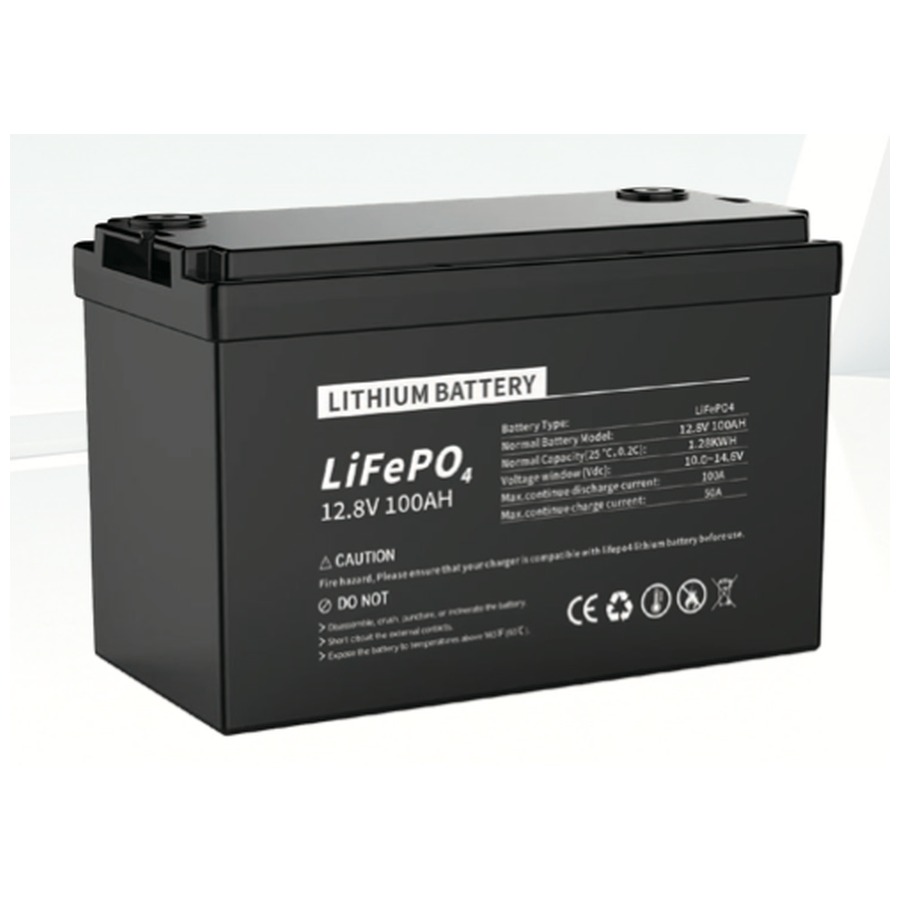 Product image
- Brand
- HighIdea
- Type
- Lead-acid replacement LiFePO4 block, 12.8 V / 25.6 V
- Typical applications
- Golf carts, RVs, marine, solar street lights, UPS and inverter replacement, floor scrubbers
- Models in range
- HD 12.8V100Ah, HD 12.8V200Ah, HD 12.8V280Ah, HD 12.8V314Ah, HD 25.6V100Ah, HD 25.6V206Ah
- Category
- Storage Batteries
The replacement market is bigger than the new-build market
Most lithium sold into golf carts, RVs, boats and street lights is not bought as lithium — it is bought as a replacement for a lead-acid block that has died. The HD series is built for that purchase: standard plastic case sizes, bolt terminals, and a BMS inside the case so the customer's existing wiring and fuse remain valid.
The engineering difference is the cells. A 12.8 V 100 Ah block uses four 3.2 V 100 Ah prismatic cells in series, capacity- and resistance-matched, with a balancing BMS. The same case in AGM would weigh 30 kg; the HD weighs 10 kg, which matters when the block is lifted into a battery box on a boat.
What "drop-in" does and does not cover
It covers dimensions, terminal layout and discharge behaviour. It does not cover charging. A lead-acid charger holds a float voltage that leaves a lithium block at 80–85 % state of charge, and an equalisation cycle will trip the BMS on over-voltage. Before fitting, check the charger for a lithium setting or a programmable profile: 14.2–14.6 V absorption per 12.8 V block, float at 13.5 V, no equalisation.
Where the charger cannot be changed, the block still works but delivers less usable capacity — a fact worth stating in the quotation rather than discovering at commissioning.
Where the 25.6 V blocks fit
Two blocks in series make a 25.6 V battery for 24 V systems: trolling motors, small off-grid inverters, mobility scooters and floor scrubbers. Using one 25.6 V block instead of two 12.8 V blocks halves the number of busbars and removes one set of terminals from the maintenance list.
Key Features
- 12.8 V in 100, 200, 280 and 314 Ah; 25.6 V in 100 and 206 Ah
- 1.28 kWh to 4.02 kWh per block
- Plastic case in standard lead-acid footprints
- Grade A cells with a matched BMS, 3,000+ cycles
- Optional Bluetooth monitoring module
- Over-charge, over-discharge, over-current, short-circuit and over-temperature protection
- Suitable for inverter and UPS replacement where the charger supports lithium
- High energy density — roughly one-third the weight of the equivalent AGM block
Applications
Golf cart and mobility
Replaces four 12 V 100 Ah AGM blocks at a third of the weight, with more usable capacity for the same volume.
RV, marine and off-grid
12.8 V blocks drop into existing battery boxes; 25.6 V blocks suit 24 V trolling motors and small inverters.
Solar street lighting
Deep nightly cycling with a BMS that cuts off before cell damage, in a case that fits existing poles.
FAQ
Can I use my existing lead-acid charger?
Is it a true drop-in?
Can I mix with lead-acid blocks?
What is the cycle life?
Specification reference
| Parameter | HD 12.8V100Ah | HD 12.8V200Ah | HD 12.8V280Ah | HD 12.8V314Ah | HD 25.6V100Ah | HD 25.6V206Ah |
|---|---|---|---|---|---|---|
| General | ||||||
| Case design | Lithium replaces lead | |||||
| Battery Type | LiFePO4 | |||||
| Electrical | ||||||
| Normal Voltage(Vdc) | 12.8V | 12.8V | 12.8V | 12.8V | 25.6V | 25.6V |
| Normal Capacity (25℃ 0.2C) (Ah) | 100AH | 200AH | 280AH | 314AH | 100Ah | 206Ah |
| Normal Energy (25℃ 0.2C) (Wh) | 1280Wh | 2560Wh | 3584Wh | 4019Wh | 2560Wh | 2636Wh |
| Float Charge Voltage(Vdc) | 14.0V | 14.0V | 14.0V | 14.0V | 28.0V | 28.0V |
| Operating Voltage Range (Vdc) | 10.0~14.6V | 10.0~14.6V | 10.0~14.6V | 10.0~14.6V | 20~29.2V | 20~29.2V |
| Max. Charge Current(A) | 50A | 100A | 100A | 100A | 50A | 50A |
| Max. Discharge Current(A) | 100A | 200A | 200A | 200A | 100A | 100A |
| Terminal | M8 | |||||
| Environment | ||||||
| Storage temperature | 0 °C~30 °C | |||||
| BMS & protection | ||||||
| IP degree | IP 65 | |||||
| Storage duration | 6 25 °C 6 months at 25 °C | |||||
| Safety standard | UN38.3,MSDS | |||||
| Display | LCD | |||||
| Communication | CAN, RS485, Bluetooth, WIFI | |||||
| Protection | Overcharge protection, Overdischarge protection, Overcurrent protection, Shortcircuit protection, Overtemperature protection | |||||
| Environment | ||||||
| Working Temperature | Charge 0 °C~+50 °C;Discharge -20 °C~+50 °C | |||||
| Humidity | 0~95%(no condensation) | |||||
| Sea Level(m) | 4000m (Derating above 2000m) | |||||
| Mechanical & packing | ||||||
| LxWxH (products size, mm) | 331*171*218 mm | 522*242*218 mm | 523*269*218 mm | 523*269*218 mm | 522*242*218 mm | 523*269*218 mm |
| LxWxH (package size, mm) | 356*196*263 mm | 547*267*268 mm | 543*289*268 mm | 543*289*268 mm | 547*267*268 mm | 543*289*268 mm |
| NW (Kg) | 10.0Kg | 29.0Kg | 26.7Kg | 26.8Kg | 20.7Kg | 35.9Kg |
| GW (Kg) | 10.4kg | 20.0kg | 27.6kg | 27.7kg | 21.7Kg | 36.9Kg |
| Quantity 20GP | 1100 | 500 | 500 | 500 | 500 | 450 |
| Quantity 40GP | 2400 | 1200 | 920 | 920 | 1180 | 700 |
| Quantity 40HQ | 2400 | 1280 | 920 | 920 | 1180 | 700 |
Specifications subject to the latest factory data. Final configuration is sized against the actual load, backup runtime and site power conditions — this table is for pre-selection only.
Specifications subject to the latest revision; need other technical documents? Ask our engineers.