
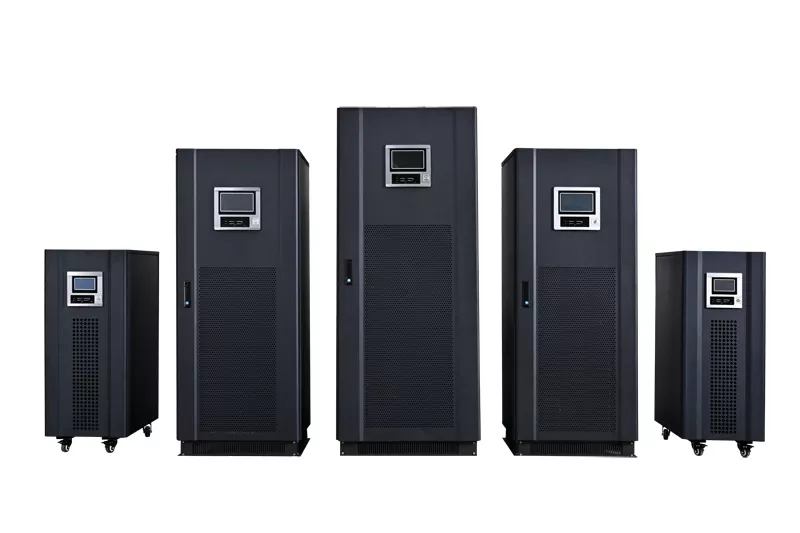
Line-frequency vs high-frequency UPS
The two topologies differ in one structural detail that drives everything else — whether an output isolation transformer sits between the inverter and the load. That transformer determines overload capability, short-circuit behaviour, weight, footprint and the battery voltage you must design around.
The short answer
Choose a line-frequency (transformer-based) UPS when the load includes motors, contactors, pumps, compressors, or anything that draws a large inrush current for a second or two, and when the site has no clean neutral or has a weak grid. Choose a high-frequency (transformerless) UPS when the load is IT equipment, the room is tight, efficiency matters, and the upstream distribution is already well behaved.
Most procurement mistakes come from buying the second type for the first kind of load, then discovering that every time a pump starts the UPS transfers to bypass.
What actually differs inside
| Line-frequency UPS | High-frequency UPS | |
|---|---|---|
| Rectifier | SCR (thyristor), 6- or 12-pulse | IGBT, PWM at several kHz to tens of kHz |
| DC bus voltage | roughly 300–500 V | roughly 700–800 V |
| Output transformer | Yes, step-up isolation | None |
| Input power factor | ~0.8 at 6-pulse | ≥0.98 with active PFC |
| Input current THD | up to ~30% at 6-pulse | typically under 3% |
| Efficiency | lower, transformer losses are constant | higher across the load range |
| Weight and footprint | heavy, needs floor space | compact, rack-mountable |
The DC bus figure explains the transformer. In a line-frequency design the SCR rectifier steps the mains down, so the bus sits below the peak mains voltage; the inverter output therefore cannot reach 230 V phase voltage on its own, and a step-up isolation transformer is mandatory. In a high-frequency design the boost rectifier pushes the bus up to around 800 V, high enough for the inverter to synthesise 230 V directly.
Overload and fault clearing
This is the practical difference buyers feel first.
A transformer-based UPS has a large magnetic reservoir. It can hold roughly 125% load for ten minutes and 150% for one minute without stress, and its output impedance is high enough to limit short-circuit current to a level the inverter can sustain. That is what lets it ride through a contactor closing or a motor start.
A transformerless UPS has an output impedance close to zero. Fault current rises almost instantly, and the inverter shuts down on overcurrent protection within a few milliseconds. For servers that is correct behaviour. For a motor it is a nuisance trip.
If your load list contains anything with a nameplate that says "motor", "compressor", "pump" or "hoist", size the UPS on starting current, not running current, and check the overload curve in the datasheet before you check the price.
Battery string design
Because the DC bus sits at roughly 400 V, a line-frequency UPS accepts a battery string in the 30–40 cell range at 12 V per block, which is a standard, well-understood configuration and needs no additional charger.
A high-frequency UPS with an 800 V bus would need around 67 blocks in series to connect a string directly. That is why most transformerless units in the 6–20 kVA class use a separate battery converter, or a lower-voltage battery with a dedicated DC/DC stage. Either approach is fine, but it fixes the battery voltage you must work with, and it constrains later third-party battery replacement.
Where each type belongs
Line-frequency: industrial plants, water treatment, substations, tunnels, steel and cement lines, marine and offshore, any site with a diesel generator that the UPS must run alongside, and any site where the load is a mixture of IT and machinery.
High-frequency: server rooms, telecom transmission rooms, edge cabinets, retail POS, medical imaging control rooms, and any building where the UPS lives in a 19-inch rack.
A note on generators
A line-frequency UPS presents a gentler load to a generator: the input rectifier draws current in a more sinusoidal shape relative to a badly filtered high-frequency front end, and the transformer provides some isolation from generator voltage distortion. On sites with an undersized generator, the transformer-based unit is usually the calmer choice — but verify the rectifier's harmonic current against the generator's alternator reactance, because 6-pulse SCR loads and small generators are a known bad pairing.
Specification checklist
Before quoting, confirm: steady-state load in kW and kVA; largest single motor and its starting method; permissible transfer time; whether a neutral is required at the output; ambient temperature; battery runtime; and whether the site will later add a generator. Those six answers usually decide the topology without further debate.
FAQ
Can I use a high-frequency UPS for a motor load if I oversize it? Sometimes, up to about twice the motor rating, but only for single motors started direct-on-line. If the motor uses a soft starter or a VFD, the VFD's own inrush limiting changes the picture and a transformerless unit becomes viable.
Does the isolation transformer protect against lightning? It attenuates common-mode surges and provides galvanic separation, which helps. It is not a substitute for a Type 2 surge protective device at the distribution board.
Which type lasts longer? Transformer-based units tolerate heat and overload better and often run 12–15 years in industrial sites. Transformerless units are more efficient but more sensitive to ambient temperature, because their power density concentrates heat in a smaller volume. Keep the room below 30 °C and both will meet their design life.
Is a line-frequency UPS louder? Yes, typically. Transformer hum plus lower switching frequency means more audible noise; plan for a plant room rather than an office.
For the product families on the industrial side of this split, see the GX series industrial-frequency UPS and the high-frequency C series. Where the load needs both isolation and a 220 V output from a 380 V feed, the H6-10K is the smaller-footprint option.