
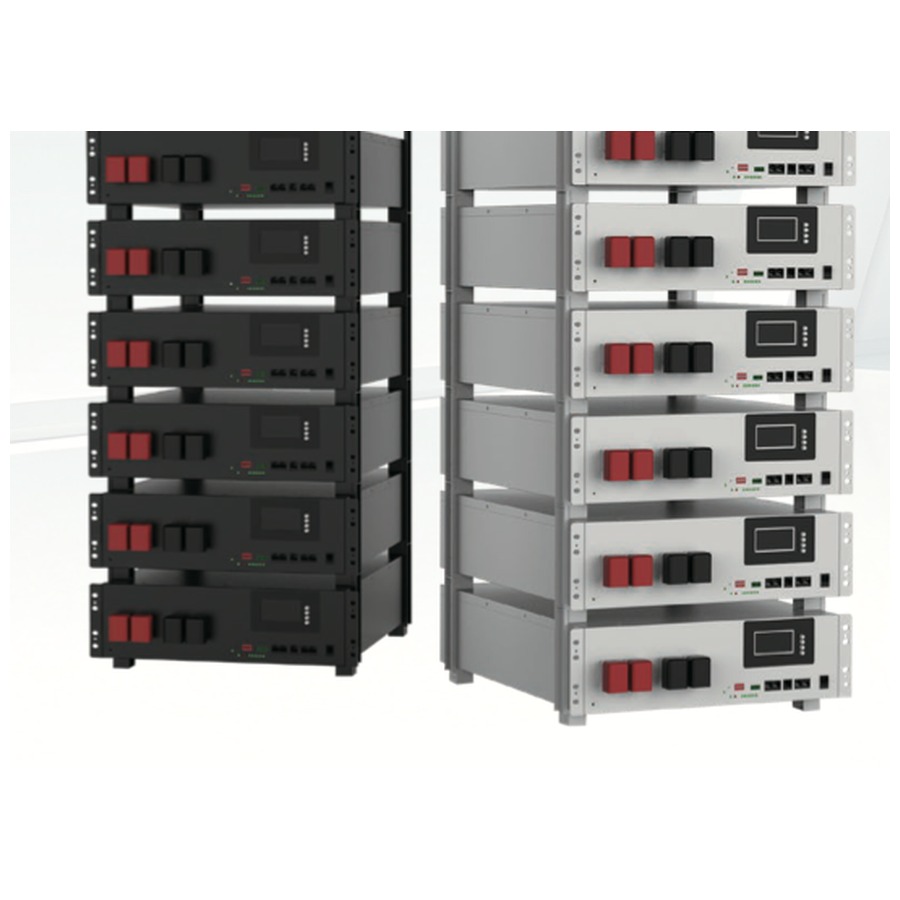
UPS battery cabinet and rack pack configuration
The battery bank decides runtime, dominates cost and fails first. Yet it is usually specified last, after the UPS is chosen, which is why so many installations end up with the right UPS, the right runtime on paper, and batteries sitting in a hot corner with no ventilation.
The short answer
Below about 3 kVA and 15 minutes of runtime, use a UPS with internal batteries. Between 3 kVA and 20 kVA with runtime under 30 minutes, a rack-mounted LiFePO4 pack inside the same cabinet is the cleanest solution. Above that, or whenever runtime exceeds an hour, move to a separate battery cabinet with its own ventilation and floor space — and check the floor loading before you order it.
Runtime arithmetic
The engineering relationship is simple, the datasheet is not:
battery Ah ≈ (load W × runtime h) / (string voltage V × inverter efficiency × usable depth of discharge)
Then apply a temperature derating and, for lead-acid, a discharge-rate derating — a battery quoted at the 20-hour rate delivers roughly 60% of that capacity at the 1-hour rate. LiFePO4 is far less sensitive to discharge rate but still loses usable capacity at low temperature.
Practical reference figures for a 0.9-efficient inverter:
| UPS | Load | Runtime | String | Approx. capacity |
|---|---|---|---|---|
| 1 kVA | 800 W | 30 min | 36 V (3 × 12 V) | 3 × 24 Ah |
| 3 kVA | 2.4 kW | 1 h | 96 V (8 × 12 V) | 8 × 38 Ah |
| 6 kVA | 4.8 kW | 1 h | 192 V (16 × 12 V) | 16 × 38 Ah |
| 10 kVA | 8 kW | 2 h | 240 V (20 × 12 V) | 20 × 100 Ah |
Treat these as a first approximation and confirm against the battery maker's constant-power discharge table. Runtime and capacity are not linear: doubling runtime needs more than double the capacity, because the discharge rate falls into a less efficient part of the curve.
Cabinet or rack?
Rack pack — a 19-inch LiFePO4 module, typically 48 V and 50–100 Ah, installed in the same cabinet as the UPS. Advantages: short DC cabling, no separate floor space, tool-free replacement, and a BMS that reports cell-level data to the UPS over CAN or RS485. Limits: weight per shelf (a 5 kWh module is around 45–50 kg) and thermal coupling — the pack sits in the same hot air stream as the UPS.
Battery cabinet — a floor-standing enclosure with tiers, ventilation and a DC breaker. Advantages: capacity scales independently of the UPS, weight is distributed to the floor, and service access is better. Limits: needs floor area, requires a DC cable run with its own voltage drop calculation, and needs ventilation designed in rather than assumed.
The mistakes that actually cause failures
Floor loading. A 20 kWh lead-acid bank in a steel cabinet can exceed 800 kg concentrated on four feet. Office floors are commonly designed for 300–500 kg/m² live load. Check the structural figure, and use a load-spreading plinth where the margin is thin.
Thermal spacing. Leave at least 10 mm between blocks and free ventilation above and below the tier. Blocks touching each other develop hot spots at the contact faces, and those are the cells that fail first.
Mixing batches. Never add a new block to a string of old ones. Internal resistance differs, the new block carries more of the charge current, and both age faster. Replace the whole string, or replace nothing.
Temperature. Every 10 °C above 25 °C roughly halves lead-acid float life. The same curve is flatter for LiFePO4 but not absent. Put the cabinet where the average is 20–25 °C, away from inverters, amplifiers and sunlight.
Torque and oxidation. Terminal connections loosen with thermal cycling. Re-torque to the manufacturer's figure at installation and annually, and apply anti-oxidation grease on aluminium or tinned terminals.
Lead-acid or LiFePO4 in the cabinet
| VRLA | LiFePO4 | |
|---|---|---|
| Cycle life | 300–500 | 2000+ |
| Volume and mass | baseline | roughly one third |
| High temperature | degrades quickly | more tolerant |
| Maintenance | terminal and voltage checks | BMS-managed, minimal |
| Upfront cost | lower | higher |
| Charge acceptance | limited | high, faster recharge |
For a room that runs warm, or where floor space and structural load are constrained, the lithium option usually wins on total cost inside five years even at a higher purchase price. For a cool, well-ventilated room with a short design life, VRLA remains rational.
Commissioning sequence
- Confirm the string voltage against the UPS nameplate DC input window — mismatch here is the most common cause of a first-power-on battery alarm.
- Measure each block's open-circuit voltage before connecting; a block more than 0.05 V off the others should not go into the string.
- Connect in the documented order, positive and negative orientation consistent throughout.
- Measure total string voltage again at the UPS terminals before closing the DC breaker.
- Set the UPS battery parameters — float voltage, boost voltage, low-DC shutdown, charge current limit — to match the battery datasheet, not to the UPS default.
- Run a real discharge test to the design load and record the actual runtime. A commissioning without a discharge test is a guess.
FAQ
Can I extend runtime later by adding a pack? On lithium systems, only if the BMS supports paralleling and the new pack matches the existing one in model, firmware and age. On lead-acid, add a complete new string in parallel with its own breaker, never blocks inside an existing string.
Does a battery cabinet need ventilation to outdoors? VRLA emits very little gas in normal float service, so ordinary room ventilation is usually adequate, but the room must not be sealed. Flooded cells need forced ventilation and are rare in UPS service today.
How often should batteries be replaced? VRLA in a 25 °C room: 4–5 years typical. LiFePO4: 8–10 years or when capacity falls below 80%. Impedance trending predicts both better than a calendar does.
Is a 48 V rack pack safe to handle? 48 V nominal is within the safety-extra-low-voltage band, but a short circuit at these currents is violent. Insulate tools, remove metal jewellery, and never work on a live string alone.
Product references: HC series 19-inch rack LiFePO4 battery, ET 1–10KRS rack UPS with external LiFePO4, CHG-48-20 charger for independent pack charging, and battery-pack sizing for the calculation in more depth.