
Selecting a UPS for a mine site, not a data centre
A mine site breaks a UPS in ways a server room never does. Here are the four decisions to settle before the purchase order — airflow in a dusty atmosphere, full output at 50 °C, the voltage the site actually distributes, and capacity margin for loads that pull several times their rated current on start.
A mine does not need a data-centre UPS with a rugged sticker on the front. It needs a unit that holds full rated output at 50 °C with coal fines on the intake filters, accepts the voltage the site actually distributes — 127 V for lighting and signalling, 380 V or 660 V for plant feeders — and stays online when a conveyor, pump or winder starts and pulls several times its nameplate current. Those three constraints decide topology, cooling and capacity margin. Battery chemistry comes fourth, and LiFePO4 answers it cleanly.
Dust is a thermal problem before it is a cleanliness problem
A fan-cooled UPS moves site air through its chassis, and that air carries the fines hanging in a shaft bottom or a coal preparation plant. The filter loads, airflow falls, and internal temperature rises although the electrical load has not changed. An over-temperature alarm follows, then a transfer to bypass on a hot afternoon, then an outage the moment the mains also fails.
Two numbers decide whether this happens. The first is the ambient temperature the unit is rated for at full load — industrial machines commonly run from −20 °C to 55 °C with full output held to 50 °C, while commercial data-centre units assume a 25 °C room and derate above 40 °C. The second is the cleaning interval. On a dusty site, clean intake filters, fan blades and heat-sink fins monthly and inspect weekly in dry seasons. Fit a washable filter, keep front-to-back airflow clear, and log cabinet temperature so a blocked filter reads as a trend rather than a trip.
Do not seal the UPS into an IP54 box to keep dust out — a sealed enclosure without airflow makes the heat problem worse. Use a heat exchanger or a filtered positive-pressure cabinet.
Match the UPS to the voltage the site already has
Mine distribution is rarely one voltage. Lighting, signalling, gas monitoring and small drills often run on 127 V, plant feeders on 380 V, larger faces on 660 V or 1140 V. Dropping a 220 V UPS behind a step-down transformer for 127 V loads costs efficiency, adds a fault point, and removes the isolation the transformer was meant to provide.
Select the native output instead. A low-voltage online unit with 100/110/120/127 V output, such as the D1-3K(R)(S) series, gives true double conversion at the voltage the equipment was built for. On 660 V boards, put a three-phase unit on the critical branch rather than the whole board, and size upstream protection for the UPS input current.
Where the site already runs a 110 V or 220 V station battery for protection and telecom, an inverter fed from that bus is often the cheaper architecture — one battery string, one charger, one maintenance regime. Across 160–300 VDC, the H series 6–20k online inverter takes the DC panel voltage directly and produces a clean output without a second bank.
Sizing for inrush and cyclic loads
The most common sizing error on a mine is matching the UPS to steady-state kilowatts and ignoring the first second. Motor starting current, transformer magnetising inrush and drive charging current all arrive before the control loop can respond.
An online UPS typically carries 110% of rating continuously, 125–150% for about a minute and 200% for a few hundred milliseconds. That window is for fault ride-through, not starting duty. If a load draws four times its rated current for a second, the capacity must sit in the rating, not in the overload curve.
| Load on the mine board | Starting behaviour | How to size the UPS |
|---|---|---|
| Conveyor or pump, direct-on-line | 6–8× full-load current, 1–2 s | Industrial-frequency unit with 3× overload for 60 s, or a soft starter |
| Winder, hoist, heavy drive | 2–3× with a VFD, higher on DOL | Size to drive input current plus 25% |
| Lighting, signalling, gas detection | 1× | Native 127 V online UPS, 30% headroom |
| Control, PLC, mine comms | 1× | Small online UPS with dry contacts to surface |
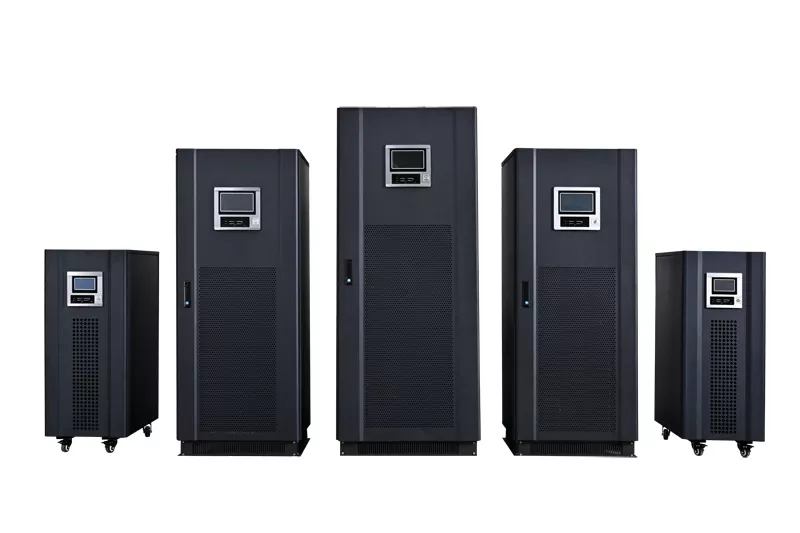
Transformer-isolated industrial-frequency units absorb this profile with more tolerance than high-frequency machines of the same rating, because the output transformer takes the surge instead of passing it to the IGBT bridge. That is why a 6–600 kVA platform like the GX series is the usual starting point for winding, crushing and pumping loads.
Consider the standby generator: its rectifier load has a high crest factor, so size the genset at 1.5–2× the UPS rating for a high-frequency unit and 1.3× for a transformer-isolated one.
Battery, temperature and the site you visit twice a year
Lead-acid still works underground, but it costs visits. A cycled string needs group replacement every two to three years, weighs roughly three times an equivalent LiFePO4 bank, and vents hydrogen into a chamber whose ventilation you may not control. LiFePO4 packs rated above 2,000 cycles at 80% depth of discharge, with a BMS reporting cell voltage, temperature and state of charge, turn maintenance from calendar-driven into alarm-driven.
Respect the temperature limit. LiFePO4 holds over 80% of capacity at 35 °C, but sustained operation above 40 °C accelerates ageing, and charging below 0 °C must be inhibited unless the pack is heated. Set the high-temperature alarm at 40 °C and put battery telemetry on RS485 or Modbus so the surface control room sees it.
Size the bank for the event, not the average — how long the mine needs to evacuate, park equipment or reach a safe state, often 60 to 120 minutes. Work back from that figure at end-of-life capacity, not at the datasheet number.
FAQ
Can a standard 220 V data-centre UPS be installed underground?
Not safely on 127 V systems, and not for long in a dusty, hot environment. The voltage does not match, the intake filter loads within weeks, and commercial units are rated for 25 °C rooms, not 45–50 °C chambers. Use a native-voltage or three-phase industrial unit and treat the enclosure as part of the design.
Is LiFePO4 safe at 50 °C ambient?
The cells tolerate it, and industrial platforms are rated to hold full output at 50 °C, but life shortens with sustained heat. Keep the battery compartment ventilated, alarm at 40 °C cell temperature, and avoid charging below freezing without a heated pack.
Do we need an explosion-proof UPS?
It depends on zone classification, not on the word "mine". Equipment in a classified gassy zone needs the relevant explosion-proof certification, and a standard industrial UPS does not belong there. Surface plant, substation rooms and non-classified chambers are normally served by ordinary industrial units.