
Industrial UPS
Transformer-isolated power-frequency UPS from 6 to 600kVA — built for hostile grids, inductive loads and sites where galvanic isolation is non-negotiable.
Industrial UPS systems are specified when the grid is hostile, the load is inductive, or the specification explicitly calls for galvanic isolation. HighIdea's GX series uses power-frequency (industrial-frequency) online double conversion with an isolation transformer at the output — a topology that trades some efficiency and footprint for absolute robustness.
If the site instead needs a compact, high-efficiency 3-in / 3-out system for standard IT or plant loads, see the Three-Phase High-Frequency UPS sub-category (EX33 tower 10-80kVA, 33ET rack 10-60kVA).
What the isolation transformer buys you
- Galvanic separation between input and output, which also solves many grounding and neutral-bonding problems on older sites.
- High overload and short-circuit withstand — motor starting currents and downstream faults are absorbed without tripping to bypass.
- Wide input voltage and frequency windows for generator co-operation and unstable utility feeds.
- Lightning protection and anti-interference design for electric-power and heavy-industry environments.
The trade-off is weight, size and a few points of efficiency. Where those costs are acceptable, the transformer-based design is still the default in power generation, transmission and process industries. The topology comparison is set out in line-frequency vs high-frequency UPS, and motor / inductive load sizing is covered in UPS sizing for motor loads.
Model coverage
GX(A) single-phase and three-phase versions cover 6-120kVA at 220 / 230 / 240Vac, with 100 / 110 / 120Vac low-voltage variants for Japan, the Americas and other LV markets. GX33 three-phase units extend the range to 10-600kVA, with parallel operation for N+1 redundancy or capacity growth. Both VRLA strings and LiFePO4 battery banks can be sized to the site's autonomy requirement; 48V LiFePO4 rack packs are available where footprint and cycle life matter.
Specifying a system
Confirm the load kVA / kW and power factor, input and output phase and voltage, the required runtime, the share of motor or other high-inrush load, and the site's grounding and lightning exposure. Bypass cabinet arrangements for this class of system are described in UPS bypass configuration. All models support OEM/ODM customization of capacity, voltage, runtime, communication protocols and branding.
Available models1 series
| Model | Type | Typical applications | Notes |
|---|---|---|---|
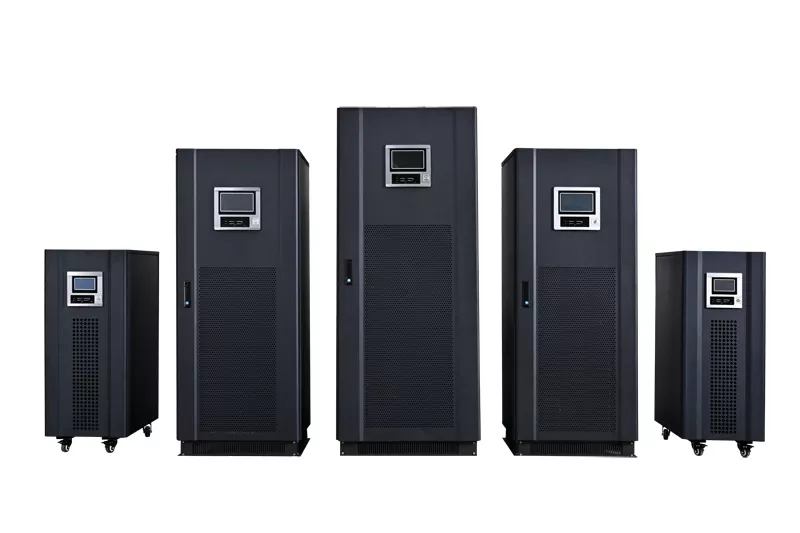 GX(A) / GX33 Series |
Industrial-frequency online UPS (transformer-isolated) | Power plants, substations, steel, mining, chemical plants | HV (220–240V) and LV (100–120V) output versions |
Models with links have detailed specification pages; unlisted models are also available on request. Capacity and quantity should be sized by our engineers against the actual load — never by nameplate rating alone.
Industrial UPS — frequently asked questions
What capacity range does the industrial UPS range cover?
Why choose power-frequency instead of high-frequency three-phase UPS?
Do I need three-phase high-frequency UPS instead?
Are low-voltage 100/110/120V versions available?
Can units run in parallel for capacity or redundancy?
What loads are these systems used on?
Other UPS Power Supply categories
Compare the alternatives within the same product line.
Lithium Battery UPS
Online UPS with built-in or external LiFePO4 — 1 to 10kVA, tower and rack, 30+ minutes full-load backup.
View detailsOnline UPS
High-frequency online double-conversion UPS, 1 to 10kVA tower and rack, pure sine wave output.
View detailsOffline UPS
Line-interactive and offline UPS from 500VA to 2000VA — cost-effective backup for PCs, POS and home office.
View details100V/110V/120V UPS
Online and offline UPS with 100–127V output for Japan, the Americas and imported equipment.
View detailsThree-Phase High-Frequency UPS
Three-phase-in / three-phase-out high-frequency online UPS, 10-80kVA in tower and rack formats for data centers, hospitals and plant infrastructure.
View details