
240V HVDC vs 48V DC: choosing the right DC bus voltage
Rack power densities keep climbing, and with them the argument for raising the DC bus voltage. This guide compares 240V HVDC and 48V DC on current, distribution losses, device ecosystem and safety engineering, then lays out a decision path — including the hybrid architecture that keeps legacy 48V equipment alive.
The short answer
For an existing telecom room or a server room dominated by 48V-native equipment, staying on 48V DC is almost always the right call — the device ecosystem is mature, the retrofit cost of 240V is real, and the energy savings rarely repay it at moderate densities. 240V HVDC earns its keep in new builds with high per-rack power (roughly 10 kW and up), long distribution runs, and equipment vendors that already offer 240V DC input modules. Decision order that works in the field: equipment compatibility first, power density and feeder distance second, retrofit cost versus energy savings last. And where both buses must coexist, the practical architecture is a 240V trunk feeding DC-DC converters down to 48V — not a forklift replacement.
Why bus voltage is suddenly a debate
Telecom has standardized on -48V DC for decades, and at the power levels of a legacy switch or a transmission rack, that choice was uncontroversial: a 3 kW cabinet draws about 63A at 48V, which ordinary busbars and cables handle comfortably. The pressure comes from density. A modern compute rack at 10 kW draws over 200A at 48V — before charging current. Every amp on a DC bus dissipates I²R heat in the busbars, cable lugs and branch fuses, so doubling current quadruples distribution losses. Copper cross-sections grow, termination torque and contact resistance start to matter, and the room's cooling budget quietly absorbs the difference.
Raising the bus voltage attacks the problem at the source. At 240V, that same 10 kW rack draws about 42A — roughly one-fifth the current, one-twentieth the I²R loss, and one-fifth the copper.
What 240V HVDC actually buys you
| Aspect | 48V DC | 240V HVDC |
|---|---|---|
| Current at 10 kW per rack | ~208A | ~42A |
| Distribution loss and heating | Significant at high density; scales with I² | Cut by roughly 80% versus 48V at equal power |
| Per-feed power at the same breaker rating | ~3 kW at 63A | ~15 kW at 63A — about 5× |
| Device ecosystem | Mature; nearly all telecom and network gear is 48V-native | Limited; the power module must explicitly support 240V DC input |
| Touch-safety class | Inside the SELV/extra-low-voltage band | Above safety extra-low voltage; reinforced insulation required |
| Retrofit cost | None — it is the installed base | High: power modules, distribution and protection all change |
| Best fit | Existing rooms, mixed legacy loads, moderate density | New high-density rooms, long feeders, copper-constrained sites |
The ecosystem column is the one that decides most projects. If the servers, routers and rectifier systems you buy do not ship with 240V DC input options, the theoretical efficiency gain stays theoretical. That is also why 240V and 48V are not competitors but layers: many deployments run a 240V trunk between power rooms and rows, then step down to 48V or 24V at the cabinet for the installed base.
The safety engineering that changes at 240V
Moving above the extra-low-voltage band is not just a label change; three protection disciplines change with it.
Insulation and clearances. At 240V DC, terminals, busbars and junction boxes must be designed for that voltage class — creepage distances, insulator ratings and enclosure IP requirements all step up, and live work procedures shift to strict de-energized practice.
DC protection devices. A DC arc has no natural zero crossing, so once struck it is far harder to extinguish than an AC arc. Circuit breakers and fuses must be rated for DC voltage and DC time constants; reusing AC-rated protection at 240V DC is a common and dangerous shortcut. Check the DC rating printed on the device, not just its AC rating.
Grounding and insulation monitoring. High-voltage DC plants typically run ungrounded or high-resistance grounded, which means a single earth fault does not trip anything — it waits. An insulation monitoring device watching bus-to-ground resistance is therefore mandatory, and bus voltage, current and insulation status should all feed the room's environmental monitoring so a developing fault is seen before it becomes an outage.
The pragmatic middle path: keep 48V, convert at the edge
Most rooms we work with do not face a binary choice. A layered architecture covers both realities:
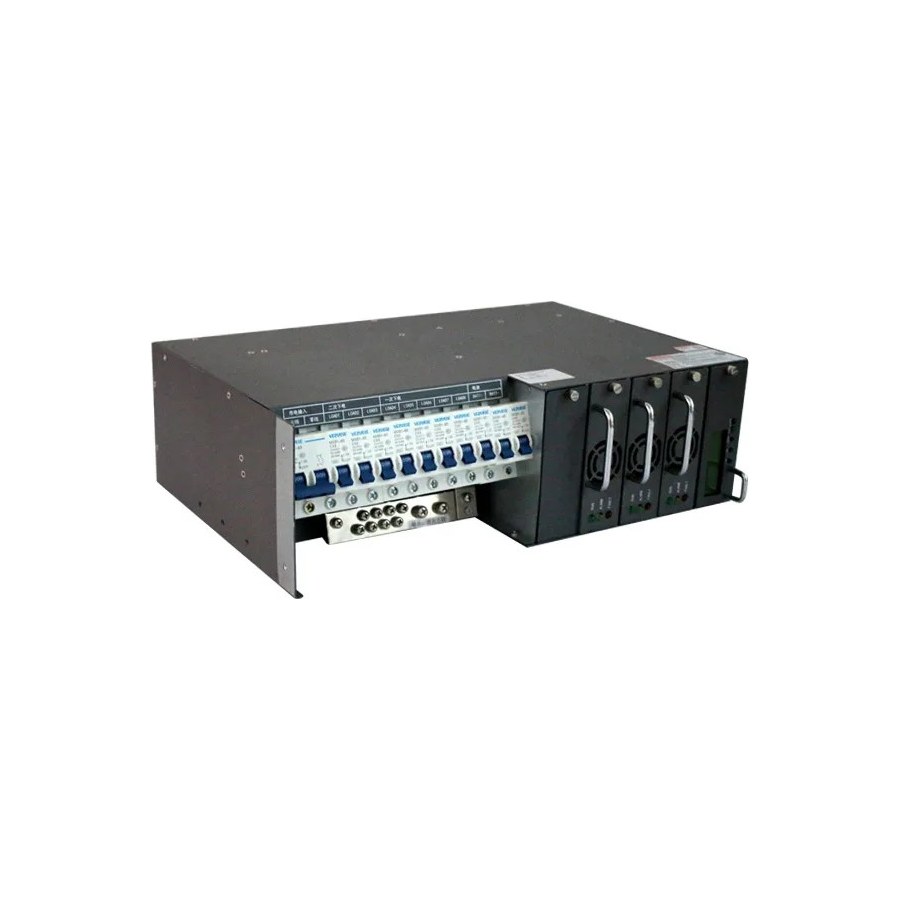
- A 48V plant sized for growth. A modular rectifier frame such as the RT 30-800A embedded power system scales from 30A to 800A with hot-swap modules, so a room can double its DC load without replacing the plant. For compact sites, the RT4860 1U embedded rectifier system delivers the same discipline — monitoring module, battery and load distribution — in a single rack unit.
- AC loads fed from the same bus. Instead of a second UPS with its own battery string, a DC-AC inverter draws from the existing 48V bank. The HTB 1-12kVA 48V to 220V inverter takes 12–72VDC input, produces pure sine 220V output with under 8 ms transfer, and recharges the same batteries it backs up — one battery bank, one maintenance schedule, both voltage worlds covered.
This is the configuration that ages best: if the room later justifies a 240V trunk, the 48V plant and its inverter edge simply become the legacy tier of the hybrid, not scrap.
Frequently asked questions
Can 48V and 240V DC coexist in one room? Yes, and it is the normal way to introduce HVDC. The 240V trunk handles high-density feeders; DC-DC converters step down to 48V for existing equipment. Keep the two distribution systems, their protection devices and their labeling clearly separated, and monitor insulation on the 240V side.
Does 240V HVDC replace the UPS? No. HVDC replaces the AC UPS's rectifier-and-inverter chain with a DC plant plus batteries, but the batteries still provide the ride-through and the rectifiers still carry the load. What disappears is one conversion stage and the duplicate battery string an AC UPS would need.
What breaker do I need for a 240V DC circuit? One explicitly rated for the DC voltage and prospective DC fault current at that point. Because DC arcs do not self-extinguish at a zero crossing, an AC-rated breaker of the same ampacity is not an equivalent substitute — verify the DC rating on the device label.
Is 240V DC more dangerous than 48V DC to work on? Yes, meaningfully. 48V sits inside the safety extra-low-voltage band; 240V does not, so it demands reinforced insulation, DC-rated protection, insulation monitoring and de-energized work procedures. That operational cost is part of the 240V business case and should be counted in it.